
Recursive Function Sample - SQL Server Recursive T-SQL Split Function
Here in this tutorial database developers can find a recursive function sample T-SQL split function which uses recursive CTE (common table expressions) structure in its source code.
If you are working as a SQL Developer or working as an database administrator (DBA), you might probably require a handy t-sql user-defined function, stored procedure or statement that will split an input string (nvarchar data) into pieces according to a given seperator character.
I'm working on my company as a developer and frequently I had to develop t-sql code blocks that will solve problems on SQL Server. T-SQL Recursive Split User-Defined function is one that I programmed for splitting text.
This sample T-SQL recursive split function will work successfully on Microsoft SQL Server 2005 and later versions up to most recent SQL Server 2019.
In addition to given split string SQL functions in this database development tutorial, with SQL Server 2016 SQL developers can use built-in STRING_SPLIT SQL Split String Function
MSSQL Split Function Example
Here is an example usage of the T-SQL SPLIT function in action
declare @s nvarchar(max)

select @s = N',,45 , 1, 56, 346 456,8,5, ,d,1,4, 5 9 ,t,,4,5 ,,, w, 3,,'

select * from dbo.split(@s,1,0)
And you can find the t-sql source code or the sql definition of the T-SQL Recursive Split Function.
CREATE FUNCTION SPLIT

(

  @s nvarchar(max),

  @trimPieces bit,

  @returnEmptyStrings bit

)

returns @t table (id int identity(1,1), val nvarchar(max))

as

begin


declare @i int, @j int

select @i = 0, @j = (len(@s) - len(replace(@s,',','')))


;with cte

as

(

  select

    i = @i + 1,

    s = @s,

    n = substring(@s, 0, charindex(',', @s)),

    m = substring(@s, charindex(',', @s)+1, len(@s) - charindex(',', @s))


  union all


  select

    i = cte.i + 1,

    s = cte.m,

    n = substring(cte.m, 0, charindex(',', cte.m)),

    m = substring(

      cte.m,

      charindex(',', cte.m) + 1,

      len(cte.m)-charindex(',', cte.m)

    )

  from cte

  where i <= @j

)

insert into @t (val)

select pieces

from

(

  select

  case

    when @trimPieces = 1

    then ltrim(rtrim(case when i <= @j then n else m end))

    else case when i <= @j then n else m end

  end as pieces

  from cte

) t

where

  (@returnEmptyStrings = 0 and len(pieces) > 0)

  or (@returnEmptyStrings = 1)

option (maxrecursion 0)


return


end


GO
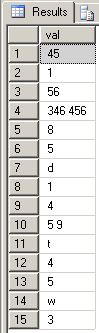
I hope this MSSQL split recursive function for splitting strings in sql will be useful for you.
Here is an other version of the above T-SQL split string function which returns a number showing the order of the splitted string.
CREATE FUNCTION SPLIT

(

 @s nvarchar(max),

 @splitChar nchar(1)

)

returns @t table (id int identity(1,1), val nvarchar(max))

as

begin


declare @i int, @j int

select @i = 0, @j = (len(@s) - len(replace(@s,@splitChar,'')))


;with cte

as

(

 select

  i = @i + 1,

  s = @s,

  n = substring(@s, 0, charindex(@splitChar, @s)),

  m = substring(@s, charindex(@splitChar, @s)+1, len(@s) - charindex(@splitChar, @s))


 union all


 select

  i = cte.i + 1,

  s = cte.m,

  n = substring(cte.m, 0, charindex(@splitChar, cte.m)),

  m = substring(

   cte.m,

   charindex(@splitChar, cte.m) + 1,

   len(cte.m)-charindex(@splitChar, cte.m)

 )

 from cte

 where i <= @j

)

insert into @t (val)

select pieces

from

(

 select

 ltrim(rtrim(case when i <= @j then n else m end)) pieces

 from cte

) t

where

 len(pieces) > 0

option (maxrecursion 0)


return


end


GO
SQL String Split Function with Additional Parameters
By adding additional parameters we can empower the SQL string split function to use it in more complex scenarios.
Following user defined function SQLSplitString accepts four parameters:
@string for input concatenated string expression
@seperator for one character seperator to split input string according to
@trim if space characters are not allowed at the beginning and at the end of the splitted pieces
@returnEmptyStrings if the developer wants to eliminate the null or empty string pieces from the returned result set
Here is the source codes of this split string function in SQL
CREATE FUNCTION SQLSplitString

(

 @string nvarchar(max),

 @seperator nchar(1),

 @trim bit,

 @returnEmptyStrings bit

)

returns @t table (id int identity(1,1), val nvarchar(max))

as

begin


declare @i int, @j int

select @i = 0, @j = (len(@string) - len(replace(@string,@seperator,'')))


;with cte

as

(

 select

  i = @i + 1,

  s = @string,

  n = substring(@string, 0, charindex(@seperator, @string)),

  m = substring(@string, charindex(@seperator, @string)+1, len(@string) - charindex(@seperator, @string))


  union all


select

  i = cte.i + 1,

  s = cte.m,

  n = substring(cte.m, 0, charindex(@seperator, cte.m)),

  m = substring(

   cte.m,

   charindex(@seperator, cte.m) + 1,

   len(cte.m)-charindex(@seperator, cte.m)

  )

 from cte

 where i <= @j

)

insert into @t (val)

select pieces

from

(

 select

 case

  when @trim = 1

  then ltrim(rtrim(case when i <= @j then n else m end))

  else case when i <= @j then n else m end

 end as pieces

 from cte

) t

where

 (@returnEmptyStrings = 0 and len(pieces) > 0)

 or (@returnEmptyStrings = 1)

option (maxrecursion 0)


return


end


GO